
Quantitative studies, whitepapers and industry analysis from the AlternativeSoft team - covering hedge fund selection, portfolio construction, risk management and alternative investment strategy.
Our most recent research publications - newly added to the AlternativeSoft applied research library.

A hedge fund NAV is a fact you verify. A private markets NAV is manager-marked, model-based and quarterly, and so are the capital calls, redemption terms and, increasingly, the exits. With evergreen funds reported past $600bn and dispersion widening, why ODD has been promoted to the audit of the number factory.
Read More
The AI conversation has moved from answering questions to carrying whole research sequences: Screen, shortlist, compare, stress, decompose, document. What a six-step coverage morning looks like done conversationally, and the five conditions that separate a defensible workflow from a string of answers.
Read More
The failure mode of AI in fund selection is not obvious nonsense but plausible nonsense: Fluent answers assembled from training memory. Why the compute-versus-recall distinction should anchor every allocator's AI policy, and five questions to ask before an assistant touches fund data.
Read More
A full operational review costs the same on a $5m ticket as a $100m one, so emerging managers get priced out before findings are ever made, and the portfolio quietly inherits the filter. How allocators keep the bar while cutting the cost of clearing it.
Read More
ION, MOVEit and CrowdStrike showed operational failures spreading horizontally through shared vendors rather than vertically through one bad manager, and DORA has made the lesson regulatory. Why third-party concentration is a portfolio question that fund-by-fund ODD cannot see.
Read More
Count the managers in the book, the depth a real review demands, and the analyst hours available, and most programmes discover their true review coverage is a fraction of what the committee assumes. The arithmetic behind the gap, and how automation closes it without lowering the bar.
Read More
Managers are increasingly drafting DDQ responses with AI, which makes answers cheaper to produce and polish than ever. The allocator's response is not to object but to shift the weight of diligence from collecting answers to verifying them against documents, filings and evidence.
Read More
The same AI theme now runs through public equities, venture, credit and infrastructure at once, which means many portfolios carry more aggregate AI exposure than any line item shows. Exposure this size should be a decision, not an accumulation. How allocators measure it.
Read More
A reported single-day loss at a concentrated technology fund put four analytical questions back on every allocation desk: Diversification measured by risk contribution, true leverage, liquidity under stress, and whether the hedges actually hedge. A strong investment thesis is not enough.
Read More
Variance was always a compromise, not a conviction. Drawing on recent research into practical portfolio optimization, we look at how allocators move beyond mean-variance defaults toward objectives that reflect how institutions actually experience risk, and what that changes in fund selection.
Read More
UK CPI fell to 2.8% in April 2026, beating expectations - but Capital Economics, Schroders and the IMF all warn of a resurgence above 4% by year-end. We examine the portfolio construction implications for pension funds, endowments and family offices.
Read More
Moody's completed the trifecta - all three major agencies have now downgraded US debt. With Treasury yields at 4.56%, oil above $105 and a $3.3tn reconciliation bill live, we examine the portfolio construction implications working through institutional books.
Read More
RIAs are forecasting a jump to 35% client alts adoption by end of 2026. Today the weighted average is 11.2%. The gap between ambition and delivery is not an investment problem - it is an operational infrastructure problem the wirehouses already know how to solve.
Read More
The largest oil supply disruption in history is reshaping portfolios, spiking inflation and exposing which allocators built genuine resilience and which did not. We examine the multi-asset implications of the Iran conflict and the chokepoint closure.
Read More
Gold surged 64% in 2025 - its biggest annual gain since 1979 - and broke $5,000/oz in 2026. We examine the three structural forces behind this historic rally and what institutional allocators should do next: geopolitical fragmentation, de-dollarisation and fiscal anxiety.
Read More
Cliffwater, Apollo, BlackRock, Blue Owl and Morgan Stanley have all gated or suspended redemptions in a single quarter. We examine the portfolio construction implications and what a rigorous liquidity framework for private credit allocations now requires.
Read MoreA full archive of quantitative studies, analyses and applied research from the AlternativeSoft team.

The average investment firm spends 2,000+ hours annually on DDQ responses. Firms are receiving 47% more DDQs than three years ago and 73% contain inconsistencies that raise red flags. We examine the hidden costs and the case for centralised cloud-based DDQ infrastructure.
Read More
AI is transforming hedge fund operations faster than ODD frameworks are keeping pace. We examine the model governance, data provenance, compliance automation and third-party vendor risks that most allocators are not yet systematically examining.
Read More
Redemption requests are surging across private credit and the semi-liquid label is under scrutiny. We examine what a rigorous liquidity framework for private credit allocations actually requires - and why most allocators do not yet have one.
Read More
Resilience is one of the most overused and least understood concepts in portfolio construction. We examine the four principles that separate fragile portfolios from resilient ones - and why traditional diversification is no longer enough in 2026.
Read More
Exploring how the convergence of model portfolio technology and hedge fund innovation is enabling a new generation of customised, alternative-inclusive investment strategies for institutional and wealth management clients.
Read More
An in-depth look at how analytics-driven model portfolios are enabling advisors and wealth managers to deliver highly customised investment solutions at scale - combining systematic construction with tailored client outcomes.
Read More
An analysis of the mounting pressures facing hedge fund managers in portfolio construction - examining how fee compression, redemption cycles and performance dispersion are reshaping strategy allocation decisions.
Read More
Institutional allocators are redefining what they expect from hedge funds. Four key demands are shaping capital allocation decisions in 2025 - from transparency requirements to co-investment structures.
Read More
With hedge fund AUM approaching $5 trillion, capital is concentrated among the largest names. This article explores how smaller managers can differentiate themselves and access institutional capital.
Read More
Family offices face mounting complexity: multi-asset portfolios, illiquid allocations, co-investments and bespoke reporting demands. This article explores how leading family offices are streamlining their investment operations.
Read More
A structural shift is underway as family offices, private banks and sovereign wealth funds increase their hedge fund allocations. This paper examines the drivers, the selection process and the analytical tools required.
Read More
This whitepaper explores how institutional-grade portfolio construction tools are becoming accessible to a broader range of investors - and what that means for the future of asset allocation.
Read More
A quantitative analysis of how adding a cybersecurity sector ETF changes the risk-return profile of a traditional 60/40 portfolio - examining correlation, volatility contribution and Sharpe ratio impact.
Read More
How institutional investors can leverage data aggregation from multiple providers to gain a more complete, accurate picture of mutual fund performance and risk.
Read More
A quantitative study examining whether CTA fund performance is driven by manager skill or macroeconomic tailwinds - analysing return patterns across different economic regimes.
Read More
A step-by-step analysis of how to screen, score and select the top 8 hedge funds for a pension fund allocation, using quantitative criteria and peer group benchmarking.
Read More
Testing which hedge fund strategies held up best across major market stress events - 2008 GFC, COVID-19 and 2022 rate shock - using historical simulation and drawdown analysis.
Read More
An analysis of crypto hedge fund performance versus traditional alternatives - examining risk-adjusted returns, drawdown profiles and correlation with traditional asset classes.
Read More
Comparing Momentum and Countertrend CTA strategies across different market regimes to identify optimal entry conditions for institutional investors.
Read More
Analysing how market-neutral hedge fund strategies performed during the COVID-19 market dislocation versus equity and credit benchmarks.
Read More
How adding hedge fund allocations to a traditional portfolio affected drawdown and recovery during the major crisis periods of the past decade.
Read More
A clear breakdown of Special Purpose Acquisition Companies - their structure, performance record and how institutional investors are incorporating SPAC exposure into alternative portfolios.
Read More
Why the Sortino ratio is a superior performance measure for high-volatility hedge funds and how to apply it in manager selection and portfolio construction.
Read More
Ranking the top 10 European hedge funds by performance between April 2020 and March 2021, with analysis of risk-adjusted returns and strategy breakdown.
Read More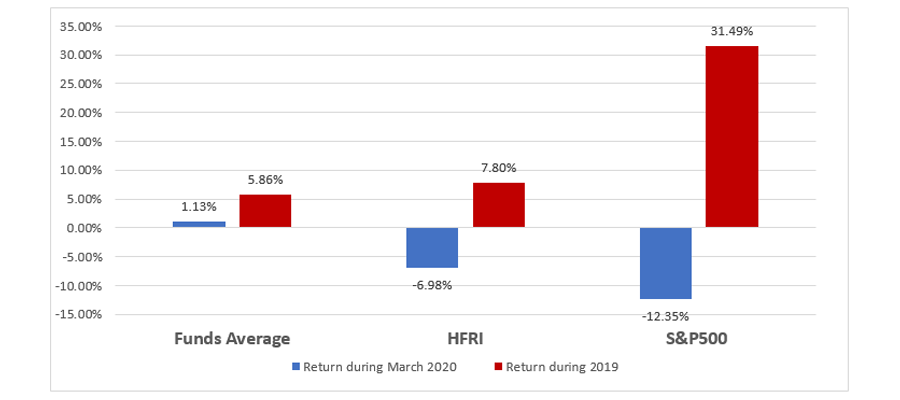
Testing whether historically high Sharpe ratio is a reliable predictor of hedge fund performance during the COVID-19 market shock of March 2020.
Read More
A portfolio construction study showing how incorporating alternative investments into a traditional equity-bond portfolio can meaningfully reduce maximum drawdown and time underwater.
Read MoreThis whitepaper explores how institutional-grade portfolio construction tools are becoming accessible to a broader range of investors - and what that means for the future of asset allocation and wealth management.
Short-form analysis and market commentary published by the AlternativeSoft team on LinkedIn.
Institutional allocators are redefining what they expect from hedge funds. Four key demands are shaping capital allocation decisions in 2025 - from transparency requirements to co-investment structures.
Read More
With hedge fund AUM approaching $5 trillion, capital is concentrated among the largest names. This article explores how smaller managers can differentiate themselves and access institutional capital.
Read More
Family offices face mounting complexity: multi-asset portfolios, illiquid allocations, co-investments and bespoke reporting demands. This article explores how leading family offices are streamlining their investment operations.
Read MoreThe analytics referenced in our research are built directly into the AlternativeSoft platform. Book a personalised demo to see how they apply to your portfolio.